NIST has finally rolled out the next set of updates to NISTSP 800-63. Hopefully, these new recommendations will change the practice of frequent password resets and contribute to the creation of a more user-friendly and secure password environment.
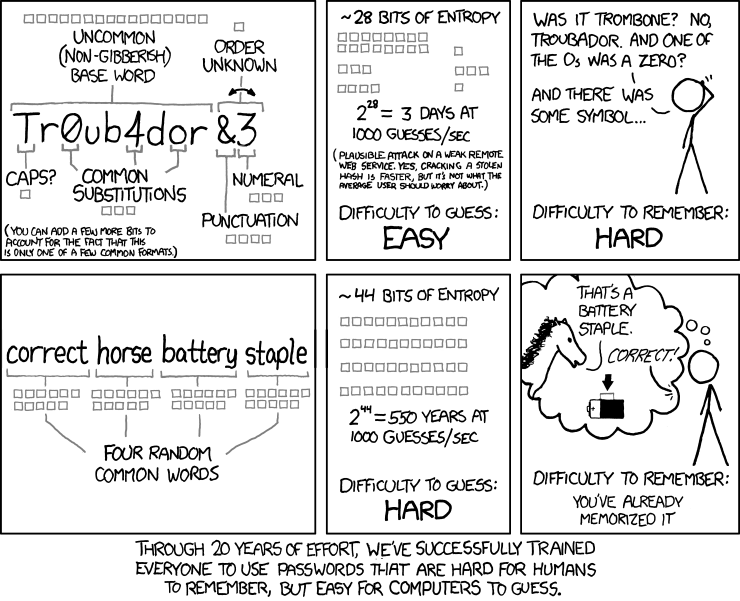
Credit: Randall Munroe, xkcd.com, CC 2.5
The main ones as of now
- Elimination
of mandatory periodic password changes. “Verifiers and CSPs SHALL
NOT require users to change passwords periodically. However,
verifiers SHALL force a change if there is evidence of
compromise of the authenticator.” NIST argues that frequent password
resets often lead to weaker passwords and encourage users to make minor,
predictable changes. Instead, passwords should only be changed when
there’s evidence of compromise.
- Establish
the block list. NIST has emphasized the importance of checking
passwords against lists of commonly used or compromised passwords.
NIST recommends that organizations maintain an updated blocklist of weak
passwords and prevent users from selecting any password on this list.
- For
storing passwords, NIST recommends using salted hashing with a work
factor that makes offline attacks computationally expensive. This approach
helps protect stored passwords even if a database is compromised.
- knowledge-based
authentication (KBA) no longer recommended (e.g., “What was the name
of your first pet?”) or security questions when choosing passwords.” Verifiers
and CSPs SHALL NOT permit the subscriber to store a hint
that is accessible to an unauthenticated claimant.”
- Drop
the algorithmic complexity song and dance (Complexity Versus Length and uniqueness)
No more arbitrary password complexity requirements needing mixtures of upper-case letters, lower case letters, special characters, symbols, and numbers. Like frequent password changes, it’s been shown repeatedly that these types of restrictions often result in worse passwords, making it easier for hackers to exploit vulnerabilities.
- Verifiers
and CSPs SHALL NOT impose other composition rules (e.g.,
requiring mixtures of different character types) for passwords.
- Verifiers
and CSPs SHALL require passwords to be a minimum of eight
characters in length and SHOULD require passwords to be a
minimum of 15 characters in length.
- Verifiers
and CSPs SHOULD permit a maximum password length of at
least 64 characters.
- Verifiers
and CSPs SHOULD accept all printing ASCII characters
and the space character in passwords.
- Verifiers
and CSPs SHOULD accept Unicode characters in
passwords. Each Unicode code point SHALL be counted as a
single character when evaluating password length.


